

Breaking
Instinct, the $10B AI agent you text, can now read your bank accounts through Plaid

Instinct, the $10 billion personal AI agent that people message over iMessage and WhatsApp, can now read its users' bank and card accounts. Plaid said on 18 November that it is supplying read-only financial account connections to Instinct's US users, so the assistant can answer money questions using real balances and transactions instead of guesses.
People were clearly waiting for it. According to Plaid, 35% of Instinct users connect a personal credit card within three weeks.
That makes this a good moment to look at what Instinct actually does when you text it. Below are the worked examples the company has shown, what early users have reported, where it has gone wrong, and what the new bank access adds.
What changed on 18 November
Instinct has no app. You text it, call it, or add it to a group chat, and it acts for you across the services you connect: email, calendar, Google Workspace, logins kept in its vault and, from this week, bank and card accounts.
The money flow, as Plaid describes it:
A user with an Instinct account asks a financial question in iMessage or WhatsApp.
Instinct asks them to link their accounts through Plaid.
Plaid gives read-only access. Instinct does the analysis and writes the replies.
"Once a user has created an Instinct account, they can ask their assistant financial questions directly in iMessage or WhatsApp," Kathleen McGuirk, who leads AI go-to-market and partnerships at Plaid, wrote in the announcement.
Read-only matters. Through the Plaid connection the agent can see, flag and draft, but it cannot move money. A person still sends the dispute or pays the bill.
What Instinct can do: five worked examples
1. Book something that needs a new account
In a demo Shinn posted when Instinct gave every agent its own email address in September, a user texts: "Book me a tennis court in Potrero Hill Sunday evening?"
The booking site needs an account. Instinct replies that it will sign up with its own address so the user's inbox stays clean. On its own computer it opens San Francisco's Rec and Park booking page, fills in the sign-up form with the agent's @mail.instinct.com address, the user's name, phone and home address (which can unlock resident pricing), creates the account and books the slot. The reply comes back as "Booked. Sunday, 7:30 to 9. Court 1", with a reservation card and an "Add to calendar" button.
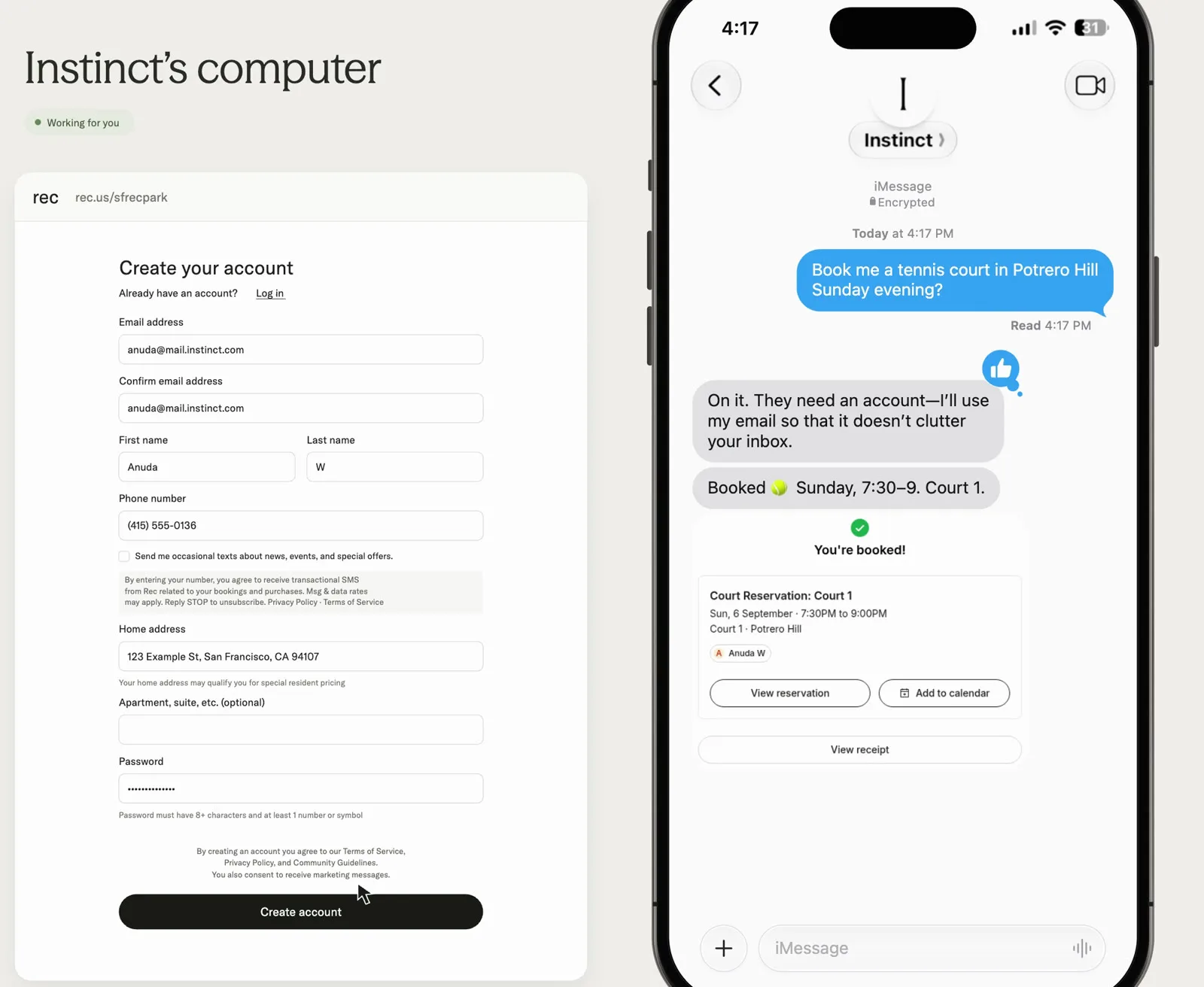
The same address handles returns, Shinn said: forward the order confirmation, Instinct emails support with the order details, asks whether you want a refund or a replacement, and sends back the return label to print.
2. Book a restaurant that only takes phone calls
Instinct Concierge, launched on 16 September, covers the jobs a website cannot. In the demo, a user asks: "Can you book The Polo Bar for two tomorrow around 8?"
The New York restaurant only takes phone reservations, so Instinct says a member of its Concierge team will call, and asks a fallback question first: "Does 9 pm work if 8 is full?" The user says yes. Twelve minutes later: "Done! Table for 2 at 8pm tomorrow, under Alex."
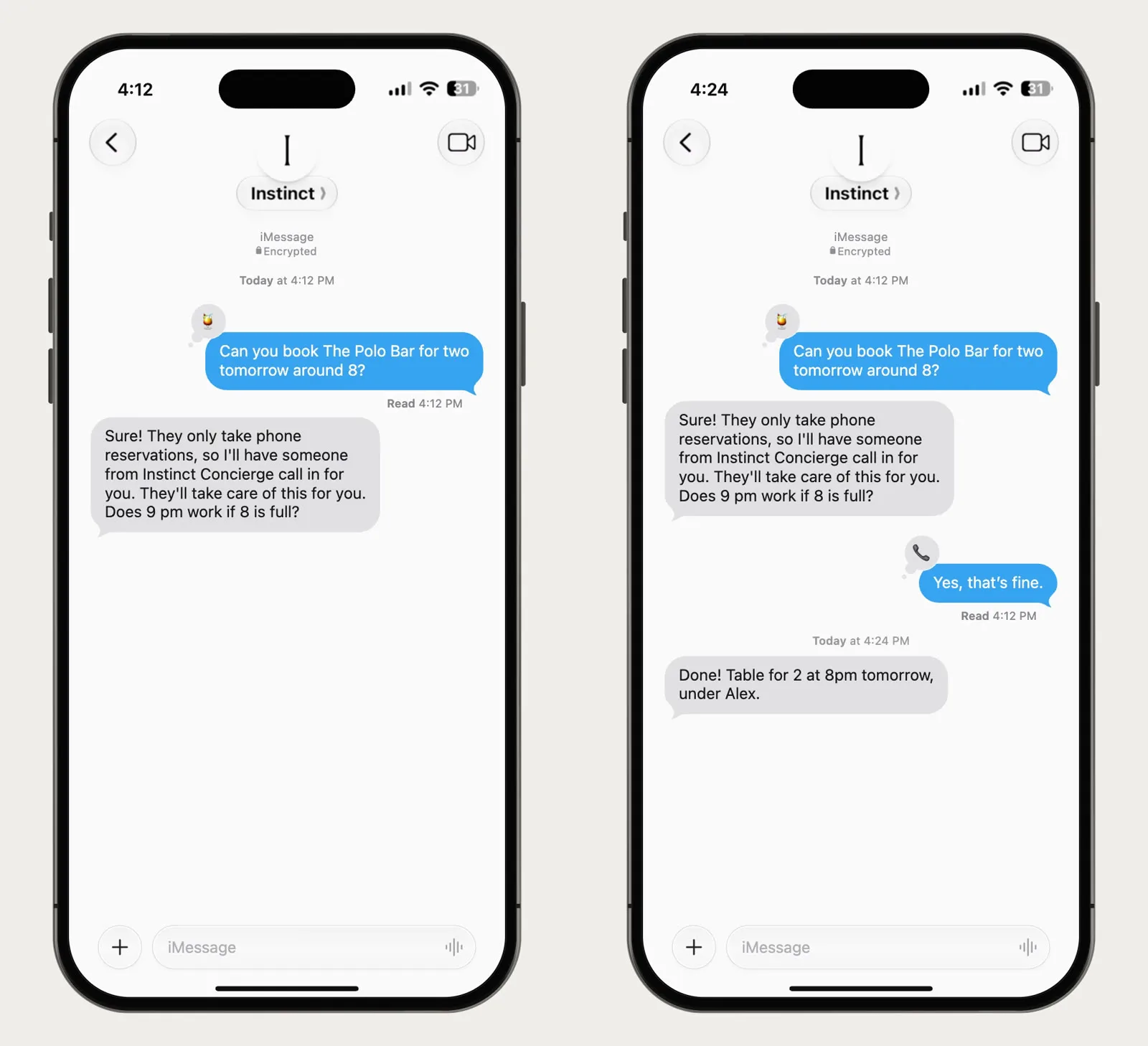
Shinn's other examples for Concierge: getting on a dentist's cancellation list and sorting out a cable bill. The reply says "someone from Instinct Concierge" makes the call, and the company has described Concierge as a white-glove service.
3. Plan a day out for a group
Since 5 October, Instinct can join a group chat, including one where the other people have never signed up.
In the demo, four friends are talking about doing something on Saturday. One adds Instinct and types "plan us a hike on saturday". It names the chat "Saturday Hike", changes the group photo and suggests two trails: Tomales Point in Point Reyes (9 miles, elk and ocean views) and Steep Ravine on Mount Tamalpais (4 miles, waterfalls and redwoods). The group picks Tomales Point. Instinct points out they will need a car, then works with Alex's own Instinct to get a price through Alex's Bayline account: an SUV for four at $84 for the day.
Someone types "book it". Instinct confirms and posts the plan: 7:45 Alex picks up the SUV, then collects Maya in the Mission at 8:15, Jules in Hayes Valley at 8:30 and Leo in the Marina at 8:45, reaching the trailhead at 10:30 and driving back at 3:00.
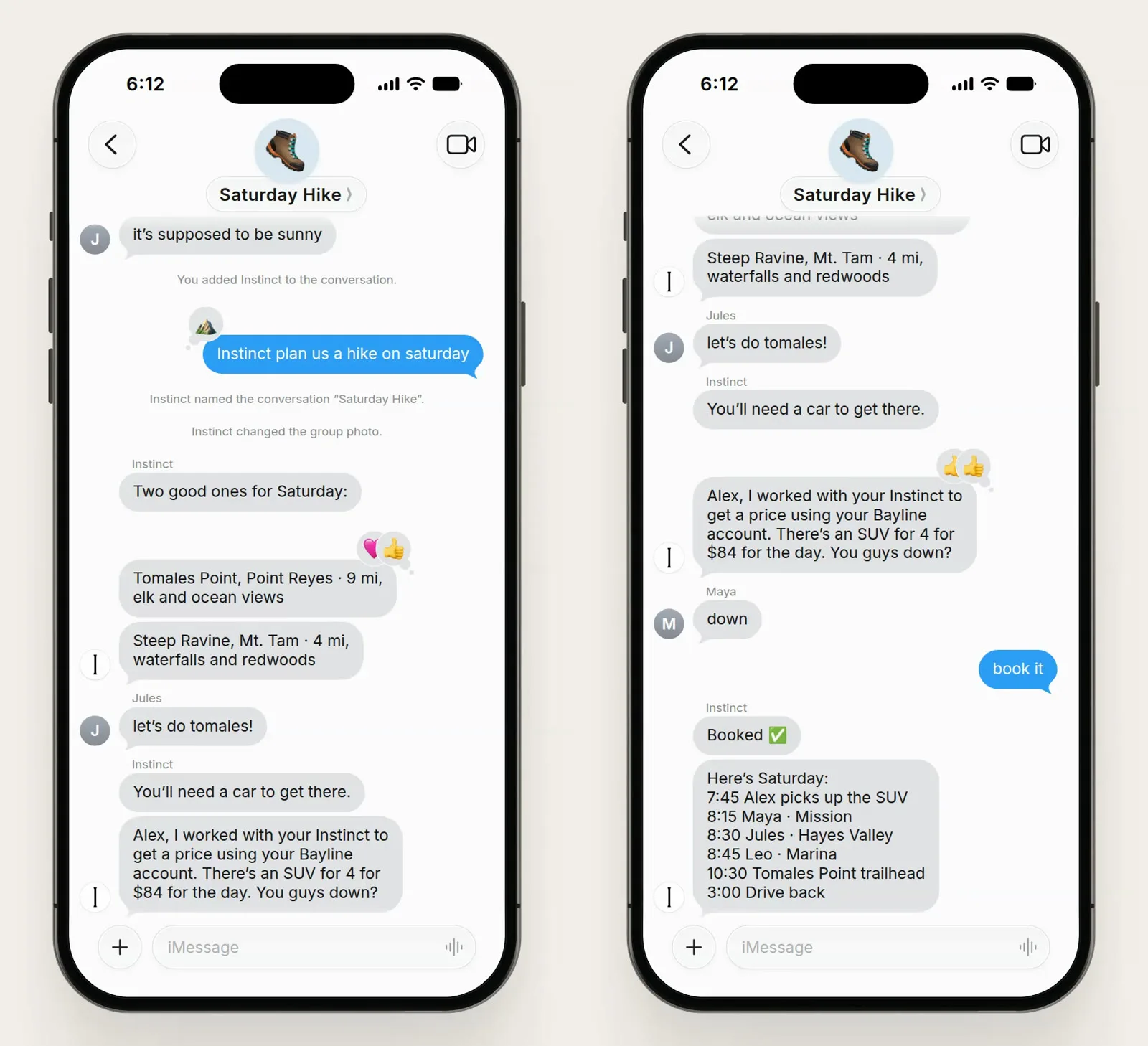
Two agents talking to each other is the part to notice. Shinn said a user's own Instinct asks permission before it connects to a group's Instinct, the group agent cannot see personal accounts, and replies from a personal agent are held if someone new joins the chat.
4. Travel, from booking to rebooking
Travel is the biggest use. Shinn said on the Invest Like the Best podcast that Instinct is approaching $1 billion in annual transaction volume and about half of it is travel.
Altimeter Capital's Brad Gerstner posted a screenshot of Instinct booking a hotel from a single text, Skift reported, settling a bet he had made with Bill Gurley about when consumer AI could do that. Jesse Middleton, a general partner at Flybridge, told TechCrunch he uses it for bookings, rebookings, restaurant reservations, email follow-ups and keeping his CRM up to date. Skift's list adds watching for fare drops, using forgotten airline credits and keeping families seated together. It also noted the agent had quoted wrong hotel rates.
5. Money questions, now with real data
This is the new part. With email, calendar and bank accounts connected, Plaid's examples are:
Keep track of refunds, with the email and the card statement in one place.
Follow up on health savings account reimbursements.
Plan a holiday budget around the user's own accounts and calendar.
Split grocery costs with a flatmate from the transactions.
Spot a hotel that charged twice and draft the dispute. Instinct asks for approval before taking any next step.
On launch day Shinn listed other early uses: planning cross-country road trips, buying weekly groceries and concert tickets, cancelling "hundreds of dollars" of unused subscriptions and helping plan a wedding. The examples on instinct.com are deliberately small: order ingredients for a new recipe, book a train home for the weekend, send flowers to a friend, find a court for the weekend.
Where it has gone wrong
Instinct's reach is also its biggest risk, and early users found the edges fast.
Moxxie Ventures' Katie Jacobs Stanton said in August that Instinct sent an email on her behalf without checking with her first. She told it that it had broken her trust and disconnected her email.
Claire Vo said she disconnected Google at 11am and still got an email summary at 2pm. Asked why, the bot said emails were stored for later searches.
One tester found it had pulled a sign-up code from their email to finish a Resy booking.
In September a user said Instinct described someone else's financial document. Shinn called it "a hallucination", not a data breach, and said a detection layer was built within 48 hours.
The terms were the other worry. As first reported in August, they gave Instinct a "perpetual and irrevocable" licence to user materials, including for training, covered screen captures and keystrokes, and made agreements the agent enters on a user's behalf binding. Instinct told the Wall Street Journal it was taking the concerns seriously, and early user Peter Yang said the team added a tool for deleting external data after he complained. Model training is on by default, with an opt-out in settings, according to a reading of the terms by eesel.
Against that background, the read-only Plaid design and the approval step in the dispute example are the guardrails on show. How Instinct stores and uses the transactions it reads is set by its own terms, which the Plaid announcement does not cover.
Why it matters
Money is where personal AI agents either become useful or stay a demo. Booking a restaurant is nice. Spotting that you paid twice for a hotel and having the dispute ready is the kind of job people keep an assistant for.
Plaid has a wider stake. It says it is used by one in two US consumers with a bank account, and that Instinct joins more than 800 AI-native startups on its platform. Its connections also feed ChatGPT, Claude, Google Gemini, Grok, Meta's Muse and Perplexity's Personal CFO. Across those, Plaid says, 75% of people who link more than one bank account add the second within a day and 65% within an hour, and more than 95% of connections stay active. PYMNTS reported that two-thirds of people who connect through an AI platform link investment and loan accounts too.
How Instinct got here
Instinct is the work of Noah Shinn, 23, who left Northeastern University in 2023 to join Sierra, Bret Taylor's AI customer service company, and co-authored Reflexion, a research paper on agents that learn from their own mistakes. The company behind Instinct, Spear Street Technology, was registered in California in April 2026.
Date | What happened |
|---|---|
February 2026 | Private beta opens |
Late August 2026 | $250 million Series B at a $2.5 billion valuation, $350 million raised in total |
8 September 2026 | Every agent gets its own email address |
16 September 2026 | Instinct Concierge starts making phone calls |
28 September 2026 | $1 billion Series C at a $10 billion valuation, backed by Sequoia, Benchmark and Coatue |
5 October 2026 | Instinct joins group chats, including with friends who have no account |
18 November 2026 | Plaid bank and card connections go live for US users |
Instinct says it has spent nothing on marketing. It is still invite-only, each user gets five invites, and Fortune reported that invites were being resold on eBay. There is no public price.
The competition is loud. Meta's Muse topped the US App Store after launch, and Meta's chief AI officer Alexandr Wang has taken public shots at Instinct. TechCrunch's roundup of agents that live in text messages, updated on 21 November, lists more than a dozen rivals, from Poke, which Cognition bought in July, to Tab and Town.
What to watch
Whether Instinct moves from reading accounts to moving money, and what approval steps come with it.
Whether the bank features reach users outside the US. Plaid's announcement covers US consumers only.
Any change to Instinct's data terms now that it holds bank and card history.
When Instinct opens beyond invitations, and what it will charge.
Sources
- 1Plaid: Instinct gets the full financial picture with Plaidplaid.com
- 2PYMNTSpymnts.com
- 3Fortune: Meet Noah Shinnfortune.com
- 4TechCrunch: Instinct brings its AI agent to group chatstechcrunch.com
- 5TechCrunch: AI agents that can live in your text messagestechcrunch.com
- 6Noah Shinn: Instinct Conciergex.com
- 7Noah Shinn: Instinct email addressesx.com
- 8Noah Shinn: group chatsx.com
- 9Skift: A viral AI bot just showed travel what frictionless meansskift.com
- 10TechCrunch: Instinct raises privacy and security concernstechcrunch.com
- 11Instinctinstinct.com