

Corvera Review: The Y Combinator Agentic OS Automating E-Commerce Supply Chains


By Jin, Founder & Startups
, updated 6 min read
Disclosure: This profile is not sponsored. It summarises public filings, Y Combinator launch disclosures, and press coverage of Corvera as of March 2026.
What Is Corvera AI?
Corvera AI is a San Francisco-based startup building an autonomous operating system for consumer packaged goods brands. Founded in 2025 and currently in Y Combinator's Winter 2026 batch, it deploys AI agents to handle the back-office work that typically buries CPG founders: processing wholesale orders, tracking inventory & forecasting demand.
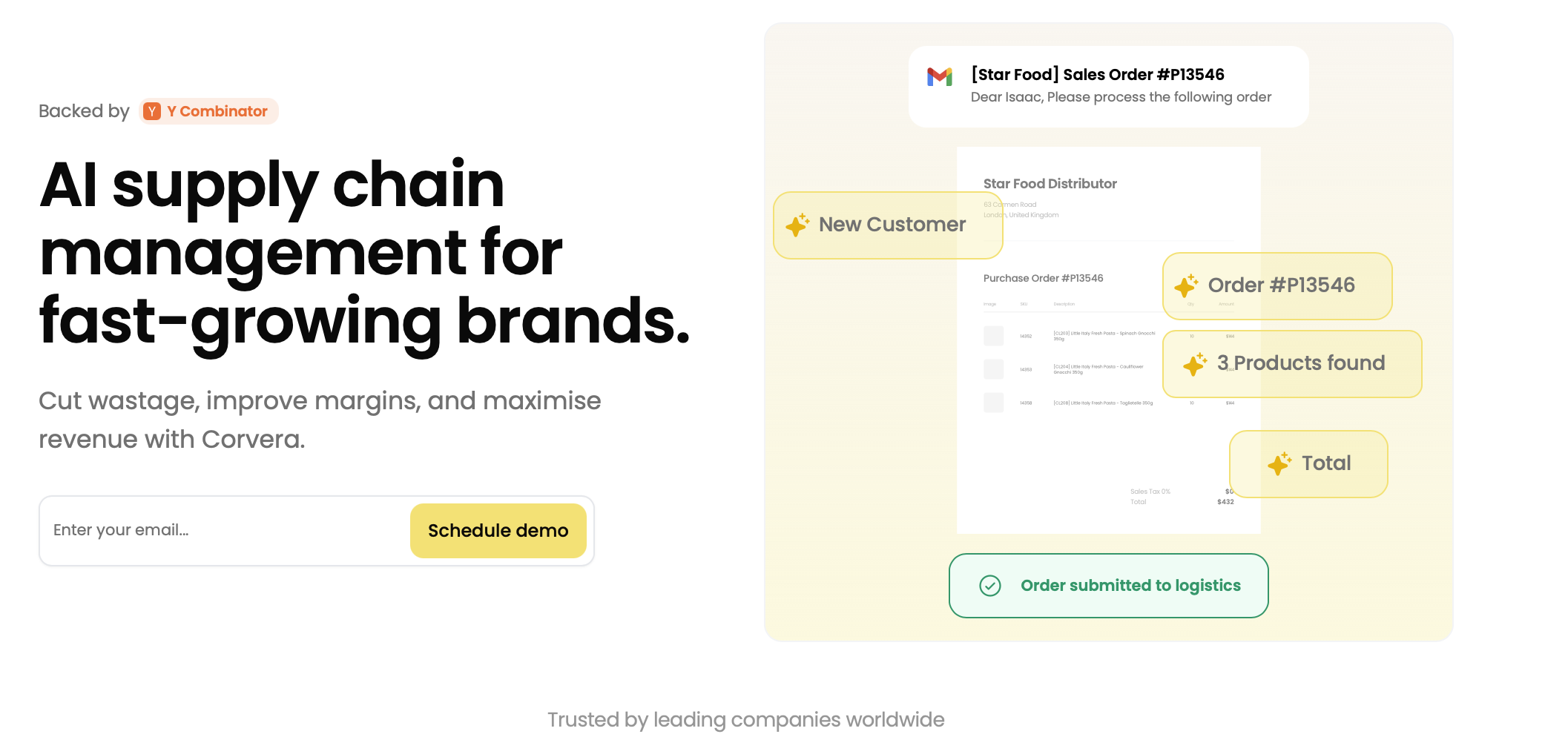
The pitch is simple:
Founders are good at building products and selling them. But they're not great at managing logistics and they probably shouldn't have to be.
The Problem It Solves
CPG brands in the US waste roughly 40% of their operational time and spend around $78 billion annually managing supply chains.
Orders arrive as unstructured PDFs and inventory data lives in five disconnected portals.
Tools like Celigo or Jitterbit snap the moment an order doesn't match their rules perfectly, which is often the case in CPG. Corvera's agents handle the messier reality: typos in invoices, non-standard SKU names, ambiguous shipping updates. They flag only when they need human intervention.
How the Platform Works
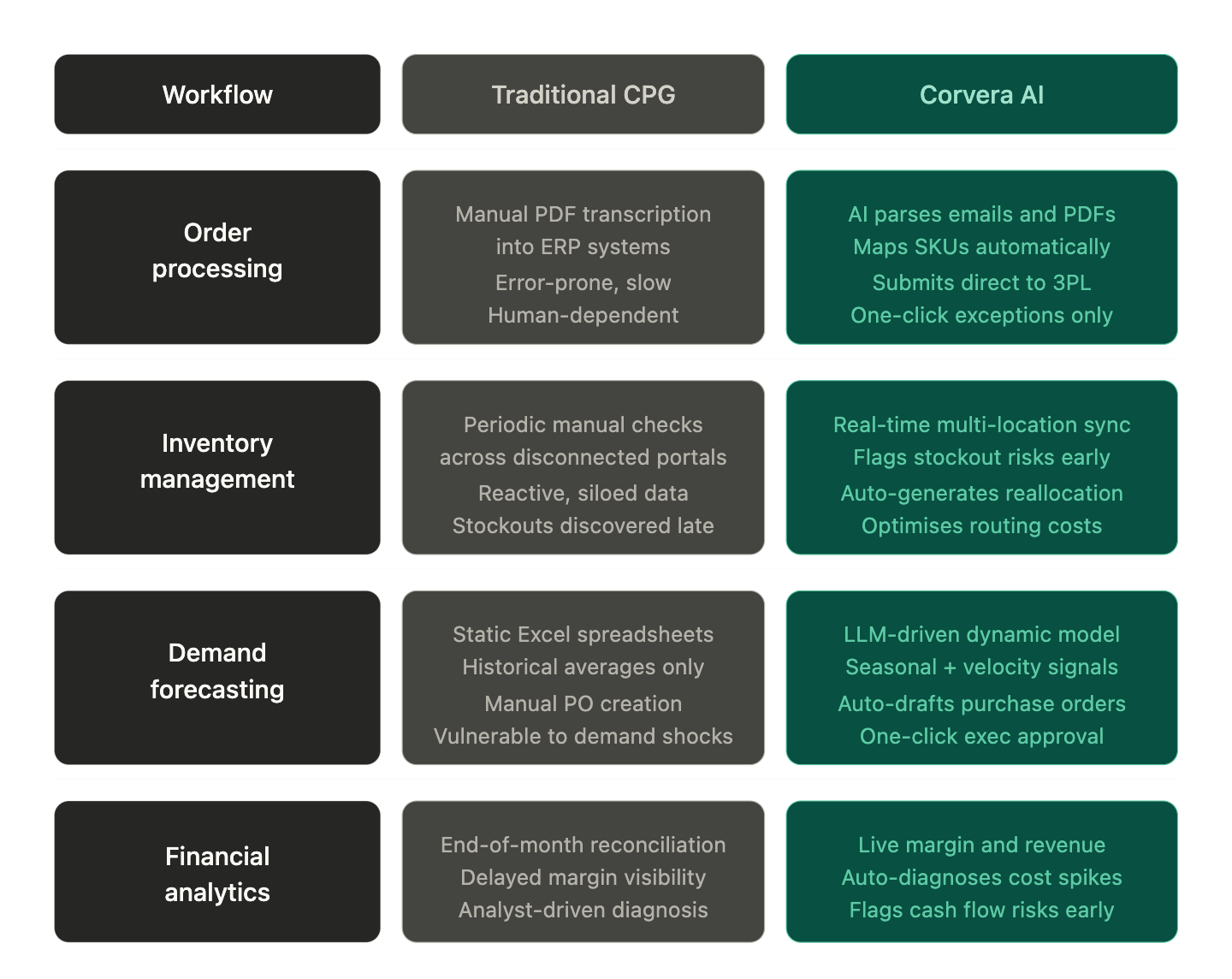
Three workflows:
For order processing, agents watch brand inboxes, pull structured data from PDFs and emails using computer vision and NLP, match line items to the product catalog, and push finalized orders to 3PL providers directly. Anything unusual gets flagged for one-click human approval rather than full manual processing.
For inventory, agents track stock across every warehouse, distribution center and fulfillment node continuously. They will flag a stockout risk three weeks out, generate options: expedite, reallocate from a slower channel, or let it go if the unit economics don't support fulfillment.
For demand forecasting, agents replace the static spreadsheet with something that actually updates. Historical velocity, seasonal patterns & current pipeline. When supply won't cover projected demand, they draft and size a purchase order and route it for sign-off.
The Team
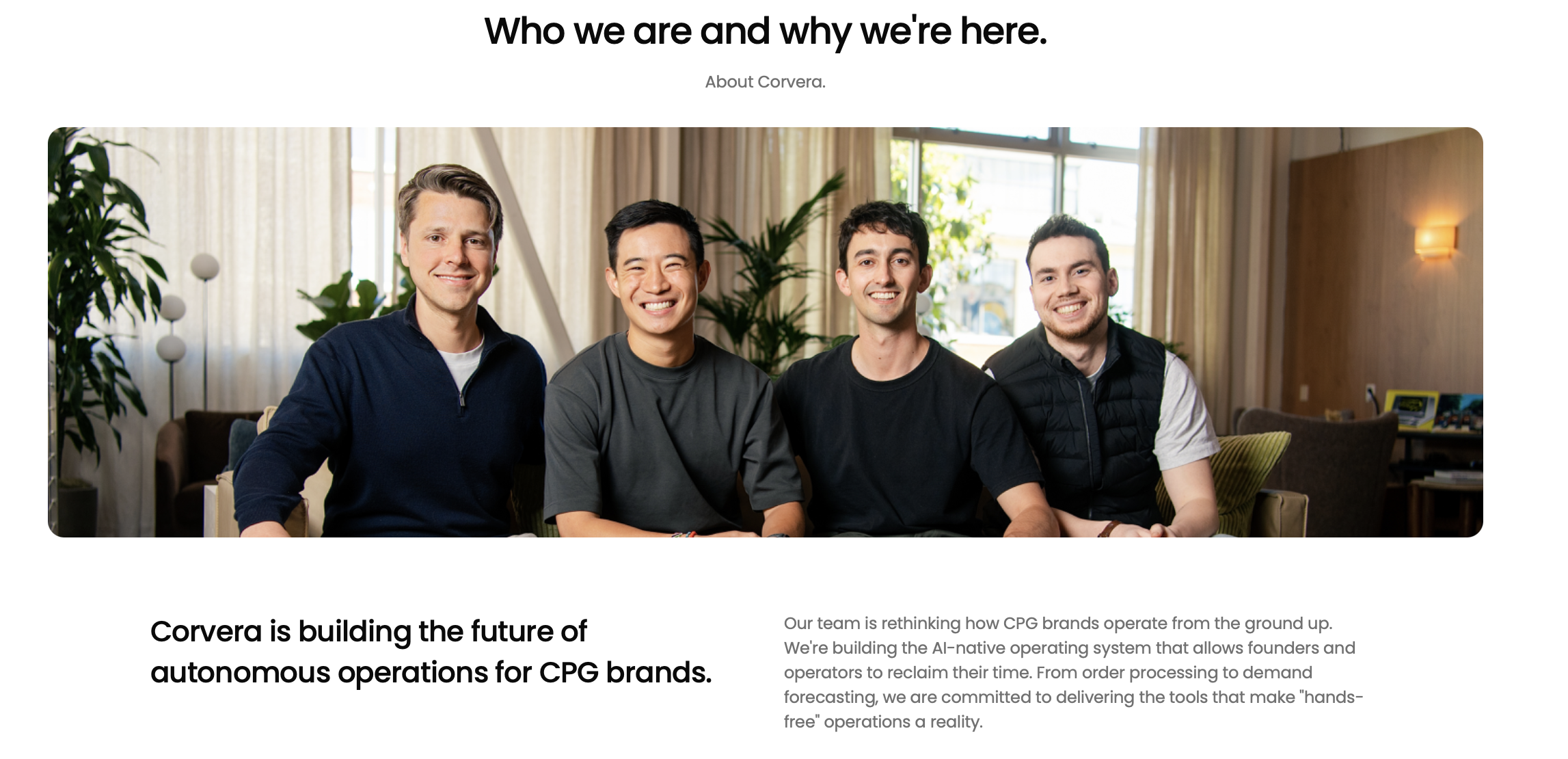
CEO Christopher Kong built Better Nature into Europe's leading tempeh brand, distributing across 5,000 retail locations in six markets. He turned down McKinsey straight out of university to build physical products instead, which means he's personally lived the supply chain chaos Corvera is designed to automate.
CTO Dirk Breeuwer led Google's Marketing AI Transformation Programme and built the first Global Data Warehouse for the Pixel hardware division. At Google, he incubated five distinct AI systems, including a multi-agent workflow platform that cut brand compliance review time by 90%. That's the technical DNA behind Corvera's architecture.
CPO Matthew Collins, a Princeton engineering graduate, previously ran product at B2B analytics platform Rosemark and spent time scaling Eton College's computer science department. This unusual combination apparently makes him good at explaining complex systems to people who don't want to think about them.
Traction and Funding
Company-reported traction (per Corvera’s January 2026 Y Combinator Winter 2026 launch post): US$0 to US$33,000 in monthly recurring revenue (MRR) in four weeks, growing at 130% week-over-week across early pilot accounts.
Twelve brands onboarded, including Better Nature, Aduna Superfoods, VITHIT, and Battersea Biltong.
In January 2026, Corvera announced a £1.5 million pre-seed round (reported as ~US$2.0 million in USD-converted profiles from Soapbox and Extruct), led by Firstminute Capital with Y Combinator, Deel co-founder Alex Bouaziz, and Runna co-founder Dom Maskell. PitchBook tracks cumulative external capital at up to US$2.52 million, reflecting that £1.5 million equity round alongside Y Combinator’s standard US$500,000 batch investment. The company is targeting brands doing over US$50 million in annual revenue.
The Competitive Risk
The obvious threat isn't a rival startup. It's Oracle NetSuite, SAP, and Shopify, which already sit inside these brands' operations and own the underlying data. If NetSuite decides to build agentic order processing natively, Corvera's differentiation gets harder to explain.
For now, Corvera's answer is interoperability. It builds on top of existing tools. That's a faster sale and a lower-risk buy for cautious operators.
Whether that's a durable moat or just a head start is the open question.
Sources
- 1Corvera: AI agents for CPG brands – Y Combinator companies pageycombinator.com
- 2Corvera | AI agents for CPG brands – Y Combinator launch postycombinator.com
- 3Corvera raises £1.5m with ‘UK first’ AI to transform FMCG business operations – FMCGMagazine.co.ukfmcgmagazine.co.uk
- 4Corvera secures £1.5m for fmcg AI supply chain tool – LinkedIn post (The Grocer coverage)linkedin.com
- 5Corvera: Building Autonomous Ops for CPG Brands – hiretop.ai bloghiretop.com
- 6Corvera AI Visibility Score: 18/100 — What AI Thinks – Pendium.ai profilependium.ai
- 7Corvera Funding: $2.0M | Complete Analysis – Extruct.ai company profileextruct.ai
- 8Corvera – AI agents for CPG ops – Yutori Scouts (YC Winter 2026 batch list)scouts.yutori.com
- 9YC AI vertical companies – Scouts by Yutori (includes Corvera launch link)scouts.yutori.com
- 10Corvera (YC W26) company profile – LinkedInlinkedin.com
- 11Corvera raises £1.5m led by Firstminute Capital (~$2M USD equivalent) – Soapbox.vcsoapbox.vc
- 12Corvera company funding profile – PitchBookpitchbook.com