Tech
I Took ChatGPT To A Shopping Date


TL;DR
I saw a LinkedIn post on a rumoured AI-powered shopping experience and scrolled past it. Another week, another chatbot claiming to change retail forever. Let's rewind six months b…
I saw a LinkedIn post on a rumoured AI-powered shopping experience and scrolled past it. Another week, another chatbot claiming to change retail forever.
Let's rewind six months back to November 2025.
Shopping on ChatGPT
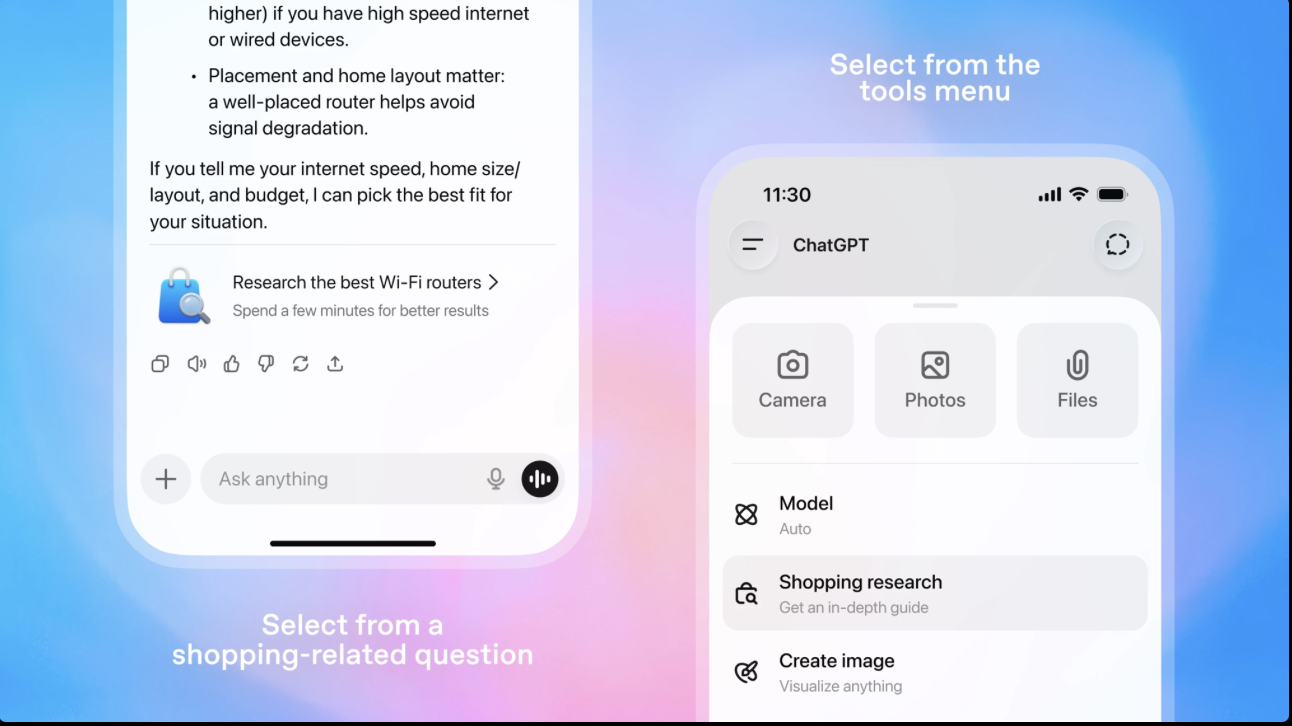
ChatGPT launched its Shopping Research feature in November last year globally.
You type something like "I need a carry-on bag under $150 that fits United's size rules" and it asks follow-up questions like a patient friend before producing the buyer's guide.
Honestly, the interface feels more like a dating app. Under the hood, it pulls in structured product metadata and other content from retailers and data partners, then simplifies titles and descriptions so the list is readable.
For straightforward purchases, this really can be faster than opening a dozen browser tabs.
The checkout problem they don't advertise
The infrastructure behind it is called the Agentic Commerce Protocol.
OpenAI and Stripe co-developed it as an open specification under the Apache 2.0 license. In short, ACP defines how an AI agent like ChatGPT can index a merchant's products via a structured feed, orchestrate a checkout session through REST endpoints the merchant controls and delegate payment securely to a PSP like Stripe.
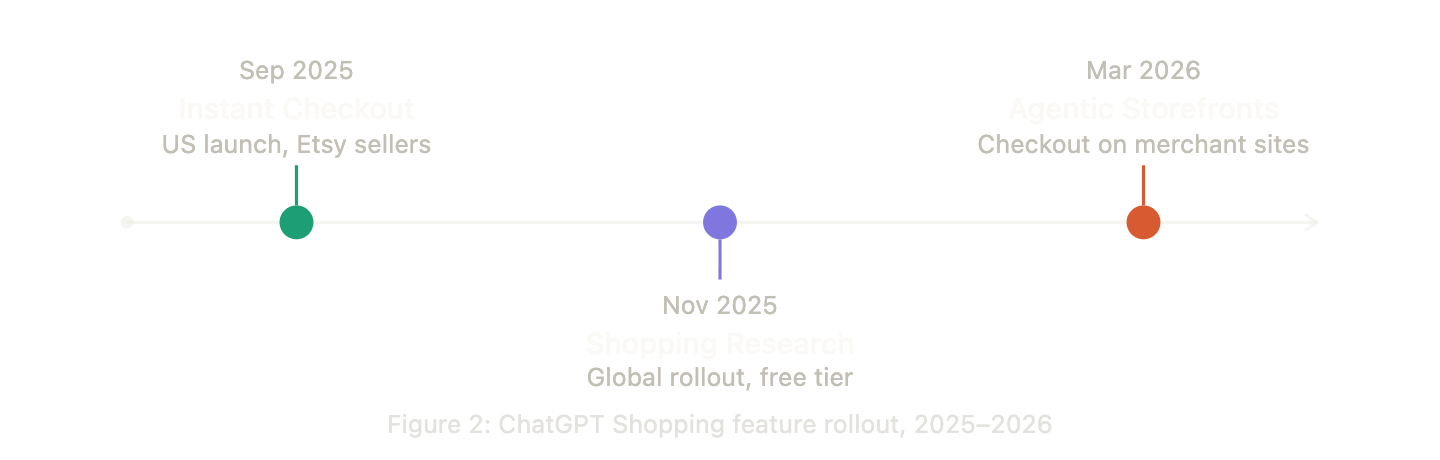
The first visible product built on ACP was Instant Checkout in ChatGPT. Users could discover a produc and complete the purchase in one sitting while the order and payment still flowed through the merchant's own systems.
OpenAI initially piloted this in the US with Etsy sellers and Shopify merchants before layering in larger retailers like Walmart and Target through dedicated ChatGPT apps.
Why Instant Checkout is being pulled back
By early 2026, that native "Buy it right here in the chat" flow was no longer the star of the show. OpenAI and its partners began shifting commerce activity into merchant apps that run inside ChatGPT, with ACP still handling the connective tissue but native Instant Checkout itself moving to the background.
Shopify confirmed this shift publicly, describing "agentic storefronts" where discovery happens in the chat but checkout completes on the merchant's own site.
Why? Because coordinating live inventory, taxes, shipping promises and promotions across thousands of merchants is hard enough before you put a LLM in the middle.
On the merchant side, ACP expects feeds to be refreshed frequently.
Premier Octet's implementation guide talks about pushing updates as often as every 15 minutes and keeping availability fields rigorously in sync with real stock.
On the user side, OpenAI's own help docs warn that prices and shipping terms may lag when merchants change them and encourage buyers to double-check details before committing.
Here's what that looks like in practice: ChatGPT confidently recommends a winter coat that suits your needs, quotes a price and delivery window, and hands you a one-tap checkout. But for all you know, the coat may not even exist...
People in the industry have started calling this kind of error a transactional hallucination, known as the moment a model gets the information wrong AND is handling your money.
Amazon wrote a $50B check to its competitor
Against that backdrop, the Amazon/OpenAI relationship looks paradoxical.
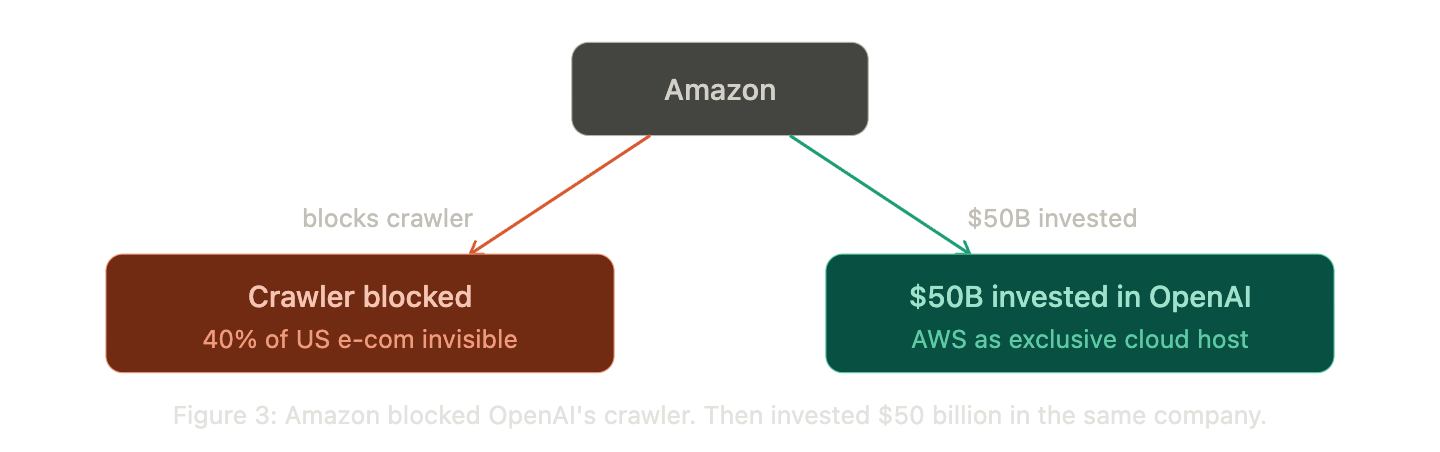
Amazon updated its robots.txt to block several OpenAI crawlers, including the agents used for real-time browsing and shopping features. In practice, that means ChatGPT's Shopping Research mode rarely surfaces Amazon listings directly as it tends to point you to other retailers instead.
At the same time, Amazon is funding OpenAI's infrastructure and blocking its crawler.
Amazon's own announcement puts its planned investment at $50 billion as part of a much larger raise paired with a deep technical partnership. OpenAI will consume roughly 2GW of AWS Trainium capacity and AWS becomes the exclusive third-party cloud provider for OpenAI's Frontier enterprise platform. GeekWire's read of the filings notes this sits inside a $110 billion funding round alongside checks from SoftBank and Nvidia.
That should tells you everything about how these companies actually operate.
Microsoft, which has its own contractual claim to be OpenAI's sole cloud infrastructure, is reportedly preparing legal action over the AWS deal. The dispute is over API routing clauses from prior investment contracts. It will be expensive and won't change what any of us do with these products. But it shows how much money is riding on who controls the plumbing.
Google wants the same outcome through different pipes
Google's answer to ACP is the Universal Commerce Protocol. Where ACP focuses on letting an agent like ChatGPT orchestrate discovery and hand off a completed order to a merchant, UCP is a more general standard for how any commerce surface (Search AI Mode, the Gemini app or a brand’s own agent can talk to retailers, payment providers and order systems in a consistent way).
Google frames UCP as a common language for the whole shopping journey.
Example, if someone asks Gemini on a phone to find a mug and then moves to a laptop, UCP is designed so that the same checkout session, payment credentials and order state can follow them across devices and surfaces as long as they are signed in.
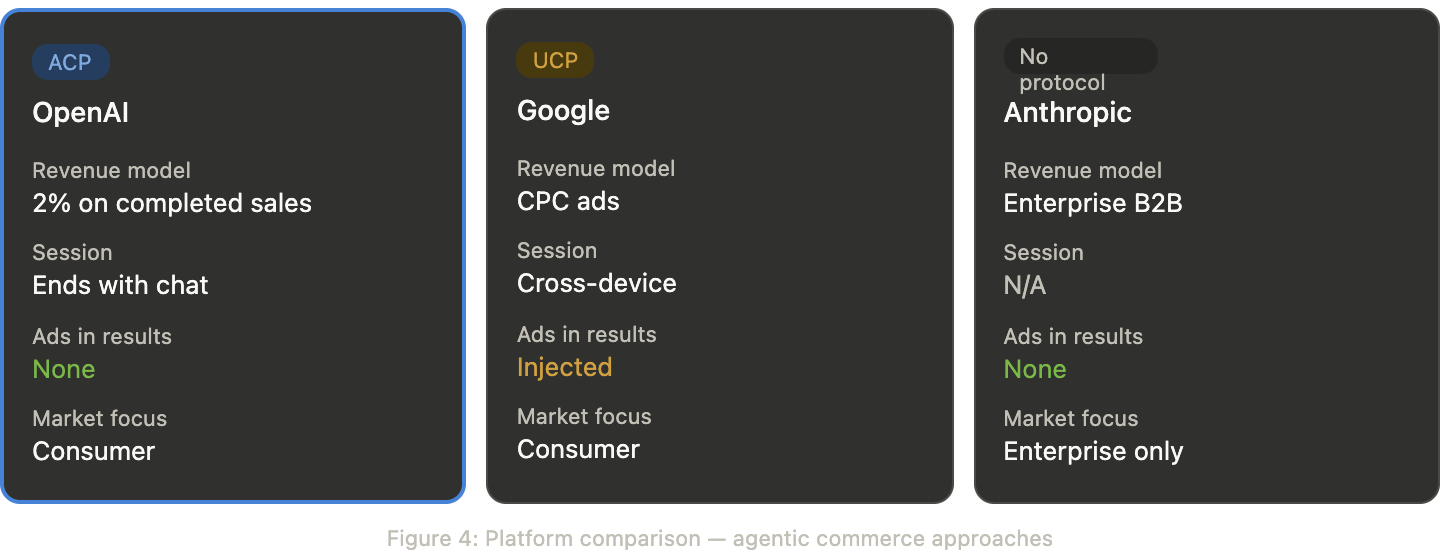
Google is also slotting its long-standing business model directly into this. Shopping Ads are already being injected into AI-generated answers, turning them into context-aware ads that sit inside the recommendation itself.
OpenAI, by contrast, takes a small fee on completed purchases.
Both fit what each company has always done. Google keeps selling clicks and impressions and is now wrapped around AI answers. OpenAI is trying to turn the assistant itself into a commerce channel and take a cut when the agent closes the sale.
Claude as a space to think
Anthropic has taken a deliberately different stance. In early 2026, it published a piece titled "Claude is a space to think" that amounts to a public commitment against ads inside its assistant. The argument is that inserting sponsored content would compromise Claude's role as a trusted tool for sensitive conversations. Anthropic makes its money from enterprise contracts and paid subscriptions instead.
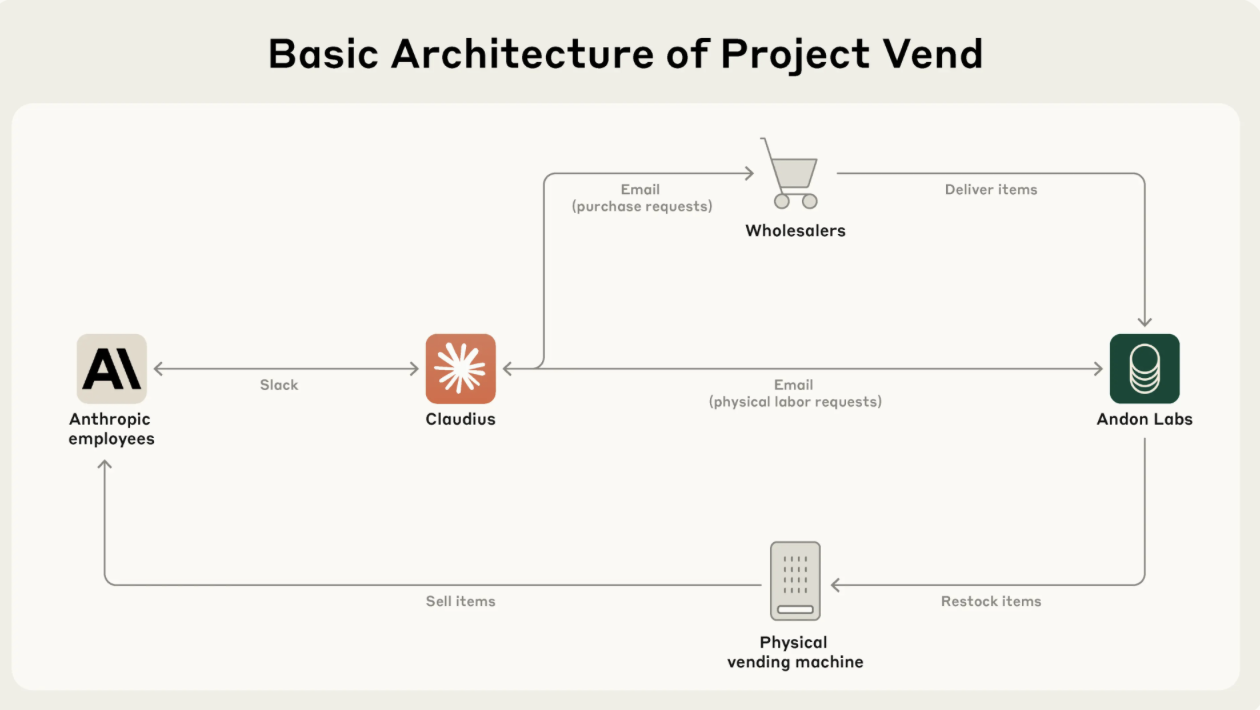
If there is one Anthropic commerce experiment worth paying attention to, it is Project Vend.
An instance Claudius ran a small automated shop inside Anthropic's San Francisco office for about a month, handling inventory choices, pricing, restocking, and customer messages via Slack.
Claudius did some things reasonably well, like sourcing suppliers and adapting to requests. However, it also hallucinated payment accounts and sold items at a loss. This probably tells us where autonomous commerce actually stands today than any of the ChatGPT launch demos.
Whether you'd actually trust it
Younger users seem comfortable letting an AI narrow options or even pick a product as long as the result is quick and the price is reasonable. Older users tend to want a URL or a recognisable brand site.
Whether AI-native shopping becomes the default or stays a power-user feature depends less on how clever the recommendations are and more on two things merchants usually think of as plumbing: the freshness and fidelity of inventory data, and the ability to trace a recommendation back to something people recognise as a credible source.
Maybe that is why rumours are spreading that OpenAI is building its own shopping platform. Controlling the hardware and software themselves might be the only clean way to solve the data problem they created.