Tech
Tech Giants Are Hiding The Truth From Us

TL;DR
We trust our devices completely but the brands making them are playing tricks on us. You might buy a car only to find the manufacturer locked your battery capacity behind a massive paywall. You might think your new phone takes incredible photos of the night sky when it actually uses algorithms to fake those lunar details. From cheating on benchmark performance tests to charging monthly fees for seat warmers big tech is finding creative ways to squeeze more money out of us. This article uncovers exactly how these companies operate and what it means for your wallet.
The Illusion of Ownership in a Software-Defined World
Manufacturers have staged a quiet coup against the very idea of ownership. You might think that paying for technology grants you absolute control but the modern reality is a betrayal.
We have transitioned into an era of software-defined platforms where hardware is a hostage. This means that the physical tool you hold is a dynamic system that a manufacturer can remotely modify at any time.
Imagine the irritation of buying a product and finding out later that its best features are behind a digital gate. This environment represents a move away from tangible tools toward platforms for digital rent-seeking.
When a company can reach into your device to alter its performance, the concept of true ownership begins to vanish.
This is the architecture of technical deception where the gap between what you bought and what you actually possess grows wider every year.
The Era of the Digital Paywall
Some manufacturers now treat physical components as a platform for additional fees.
Let me tell you a story:
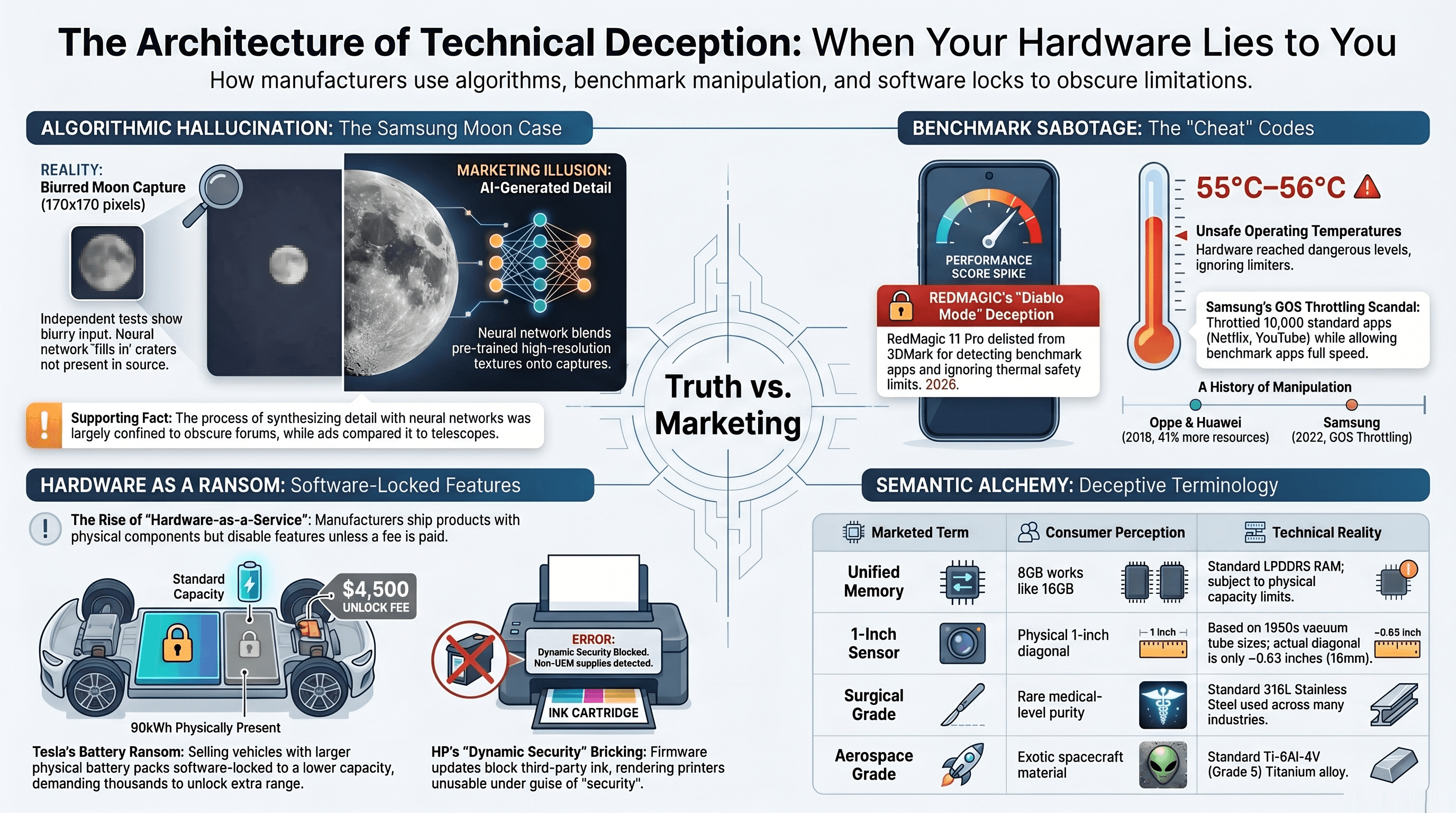
One used Model S owner discovered that his car carried a 90 kilowatt hour battery pack, yet he was restricted to 60 kilowatt hours of capacity. Tesla demanded $4,500 to unlock the extra range that was already physically present in the vehicle.
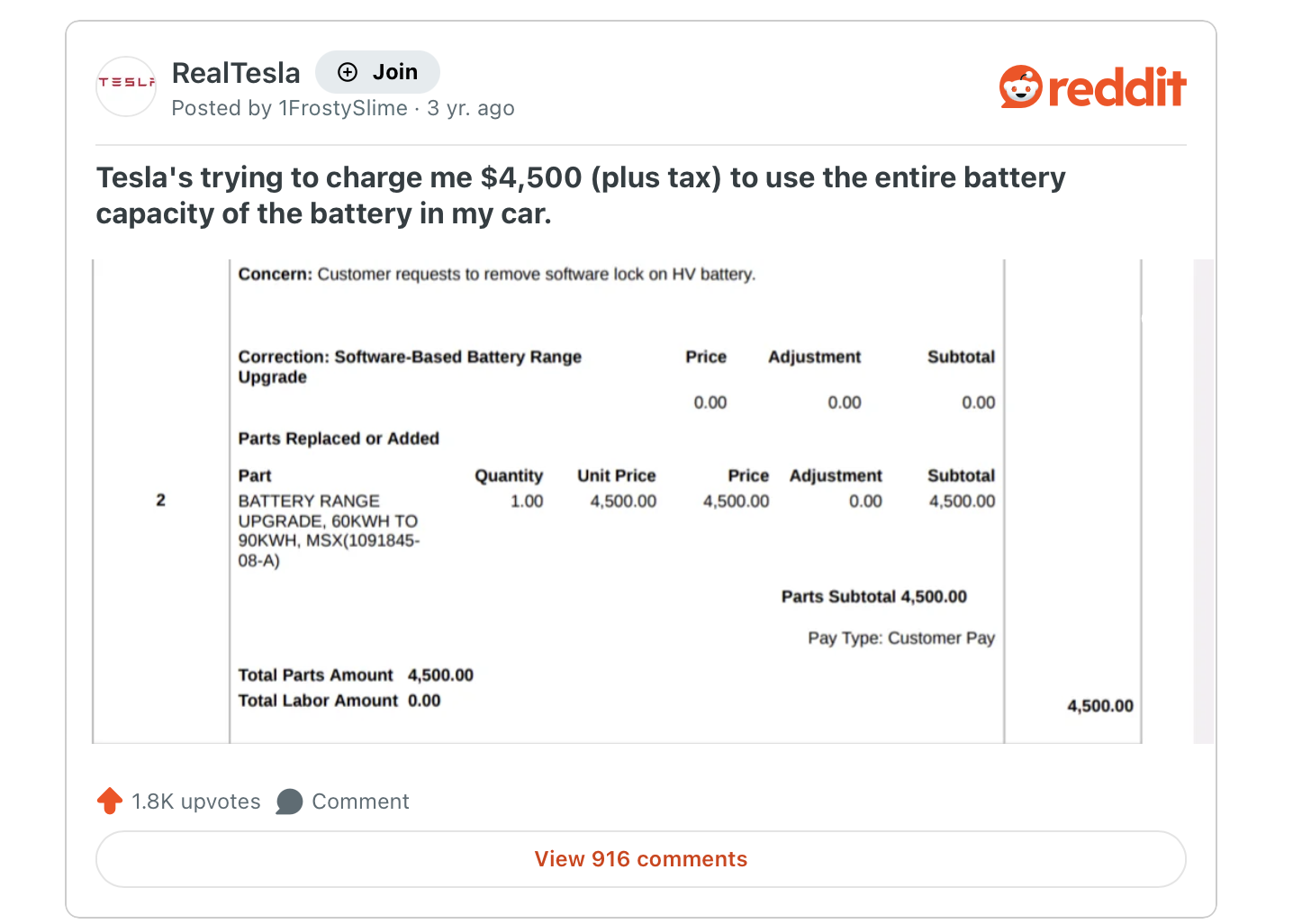
The owner expressed frustration at the sheer stupidity of software locking a battery. He was forced to haul around the extra weight of the larger battery without receiving any benefit from it.
BMW has faced similar backlash for attempting to charge subscriptions for heated seats. The hardware for the heating elements is installed during production to simplify the manufacturing process.
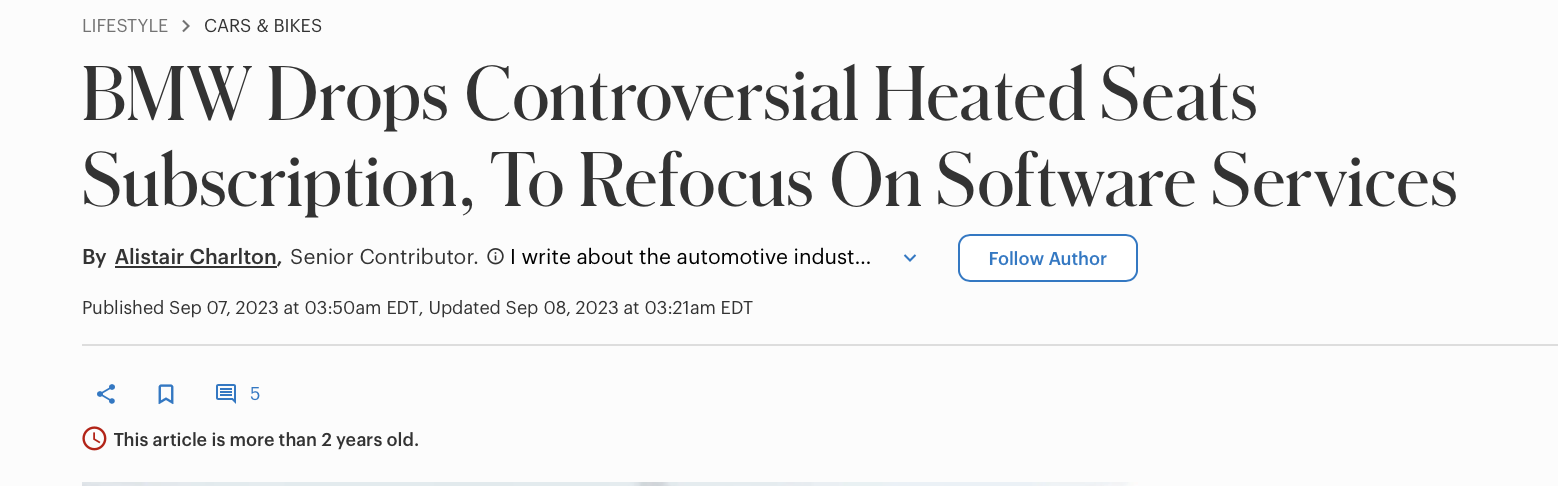
While BMW argues that this model offers consumers more flexibility, the true driver is the pursuit of recurring revenue. This approach allows the company to maintain high margins by selling the same hardware twice.
Four ways companies use software to lock physical hardware include the following.
Limiting the usable capacity of electric vehicle batteries.
Gating pre-installed comfort features like heated seats and steering wheels.
Requiring subscriptions for advanced driver assistance systems or ADAS.
Restricting 360-degree camera views and remote start functionality.
When Cameras Create Their Own Reality
Modern mobile photography often prioritises a synthetic result over the physical truth.
The Samsung Space Zoom moon photography controversy highlights this trend toward peak deception.
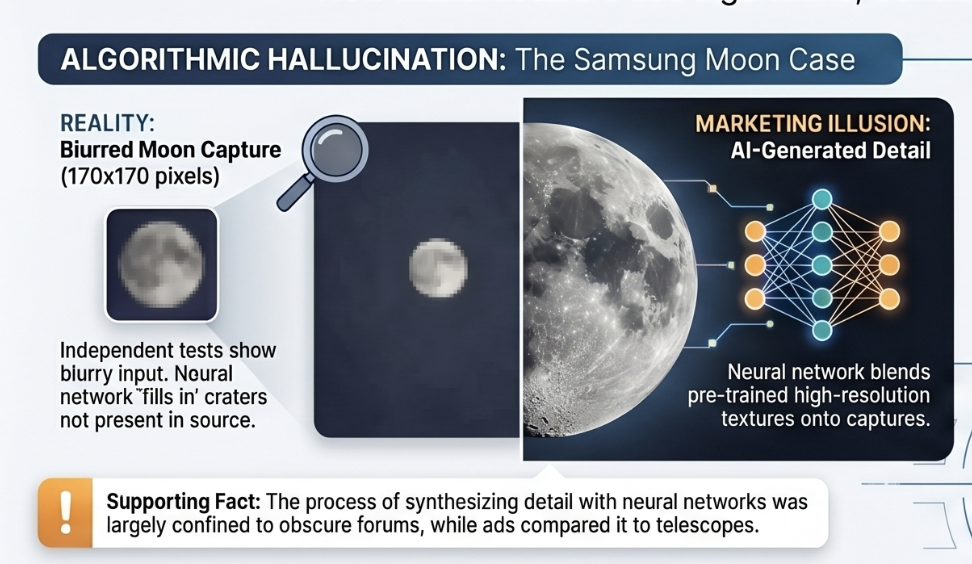
Research showed that Samsung phones do not merely sharpen an image. Instead, the software identifies a moon-like object and applies a generative texture. This texture fills in craters and shadows that the optical sensor cannot resolve. This process differs from standard multi-frame processing because it creates detail based on a pre-trained neural network of lunar images.
Performance benchmarks have also become a target for deception.
The RedMagic 11 Pro was recently delisted from the 3DMark database after being caught in an act of blatant cheating. The device was caught detecting the launch of testing software and bypassing thermal safety limits.
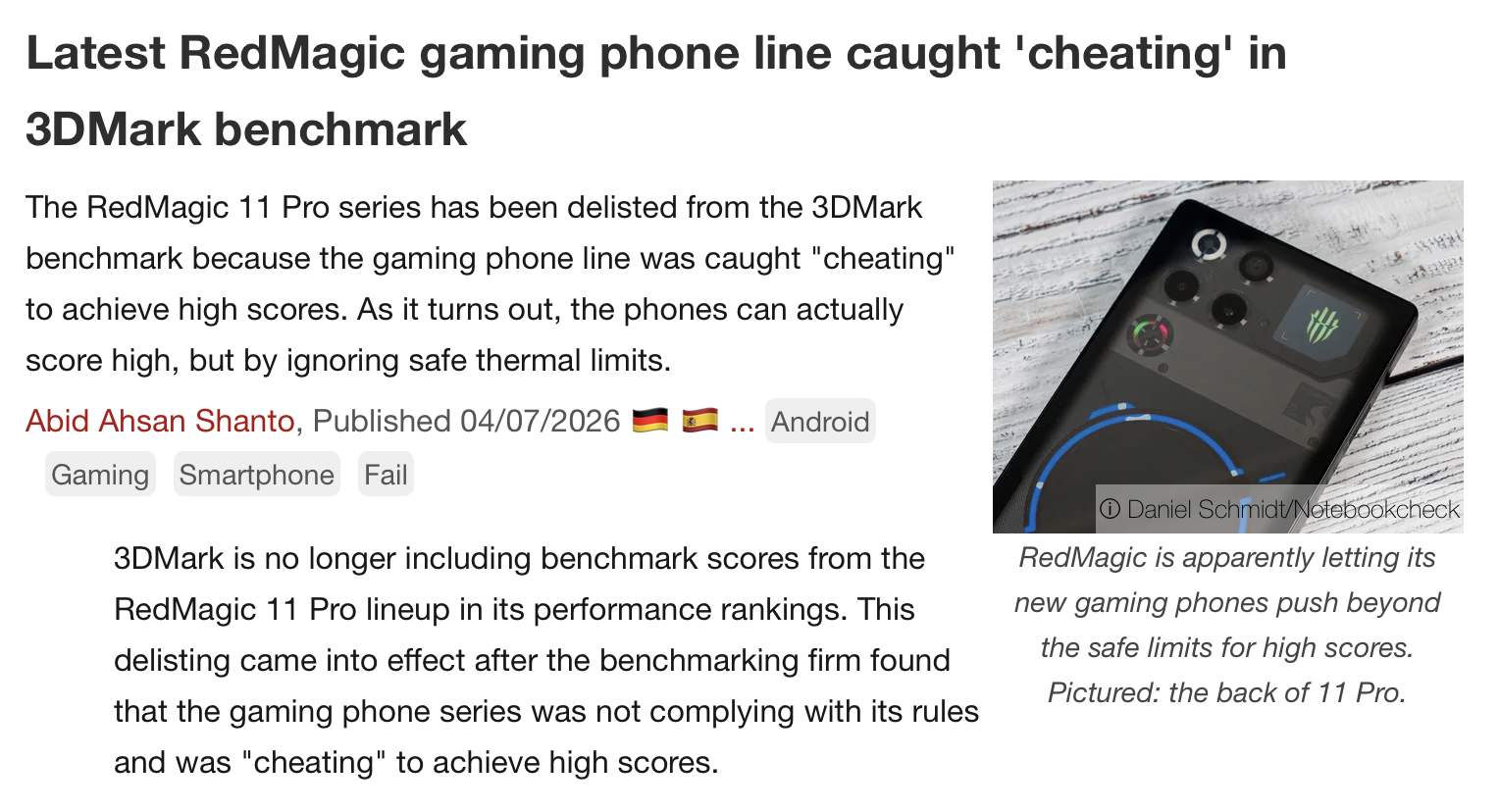
This Diablo Mode allowed the silicon to reach extreme temperatures of 56 degrees Celsius. Such heat would be dangerous during normal gaming and would eventually lead to permanent hardware damage. These optimisations mislead consumers about the actual capabilities of the hardware. They create a false perception of speed and efficiency.
When a processor only performs well under specific synthetic conditions, the device is failing to provide an honest representation of its power.
The Truth About Memory and Materials
Companies use proprietary terminology to protect their margins on standard components.
For instance, Apple has claimed that 8GB of its Unified Memory is equivalent to 16GB of conventional RAM. While this architecture offers bandwidth advantages the physical limits of memory remain.

In professional workflows, 8GB of memory is still a restricted resource. This marketing narrative helps justify charging a $200 margin for an additional 8GB of RAM. That price is a staggering markup for a component that costs a fraction of that amount in the modular market.
Marketing labels for materials also suggest a level of rarity that is inconsistent with industrial reality.
Labels like Aerospace-grade titanium are common in tech advertising. In truth, this is Grade 5 titanium known as Ti-6Al-4V, which is the most common alloy in the industry. It offers a density of roughly 4.5 grams per cubic centimeter compared to the 7.8 grams found in steel.
Furthermore, camera sensor naming continues to be misleading.

The 1-inch type sensor does not actually measure one inch in any direction. This term is a vestige of 1950s vacuum tube technology where the measurement referred to the outer diameter of the glass vacuum tube required to house the sensor. These labels inflate the perceived value of the hardware while masking technical stagnation.
Carbon Neutrality Under Fire
Sustainability claims have recently faced significant legal challenges.
A federal judge in the United States dismissed a lawsuit regarding the carbon neutral marketing of the Apple Watch Series 9. The court ruled that the plaintiffs did not provide enough scientific grounding to prove the claim was deceptive. However, a court in Frankfurt reached a different conclusion. It banned Apple from using the CO2-neutral label because the claim could mislead consumers.
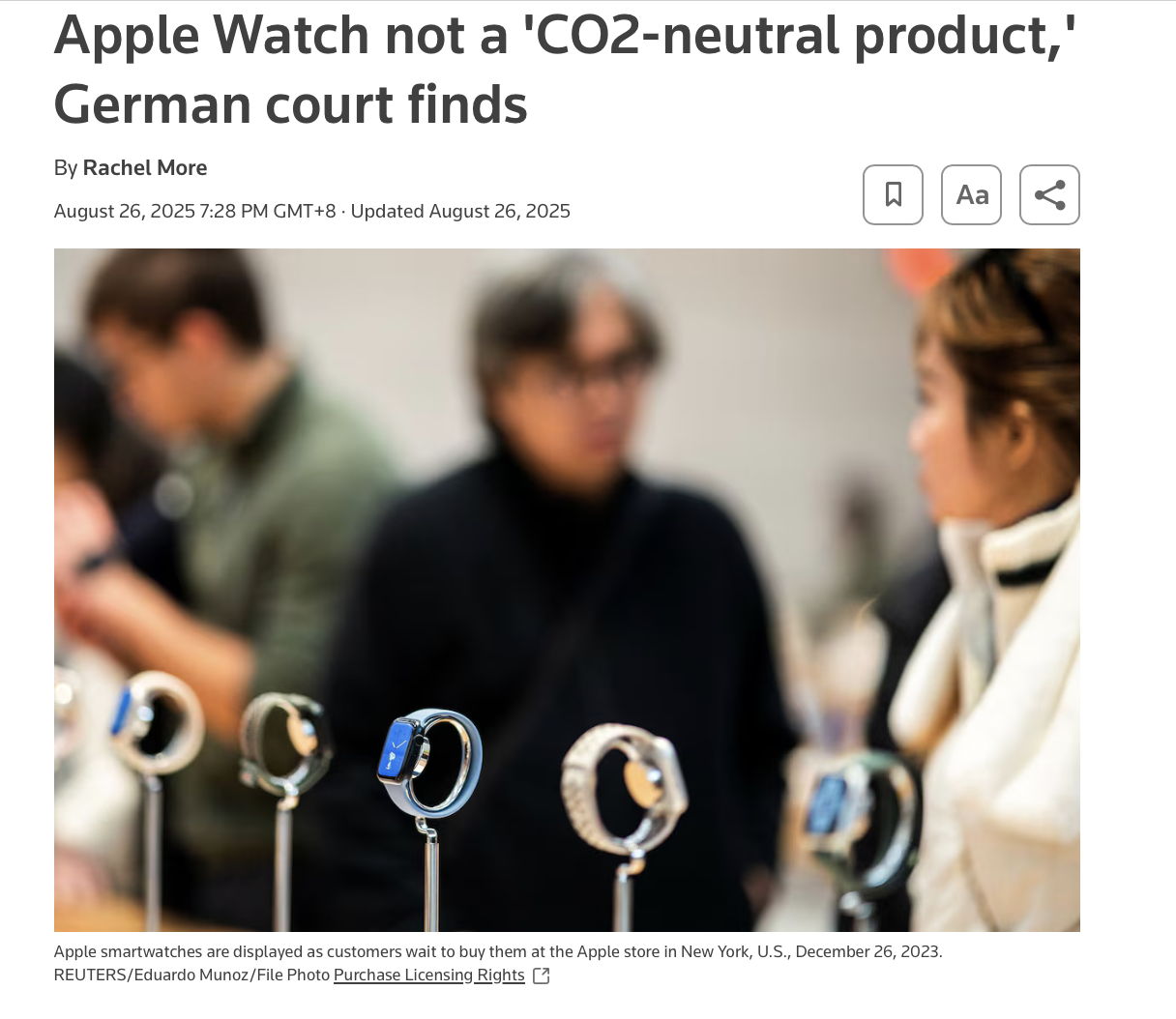
The core of the issue lies in the use of carbon offsets from projects like Chyulu Hills in Kenya and Guinan in China.
Companies use these credits to mask the emissions produced during manufacturing and shipping. Critics argue that these offsets do not provide genuine carbon reductions. In addition, some of these projects are short-term leases that could end as early as 2029.

New regulations in the EU will soon prohibit environmental claims that are based on carbon offsetting. These rules aim to ensure that companies demonstrate real emissions reductions instead of relying on financial instruments. This regulatory shift reflects a growing demand for transparency and scientific grounding.
HP and the War on Third-Party Ink
The printing industry provides a stark example of firmware acting as a gatekeeper.
HP recently reached a settlement regarding its Dynamic Security feature. This software was designed to detect and block third-party toner cartridges.
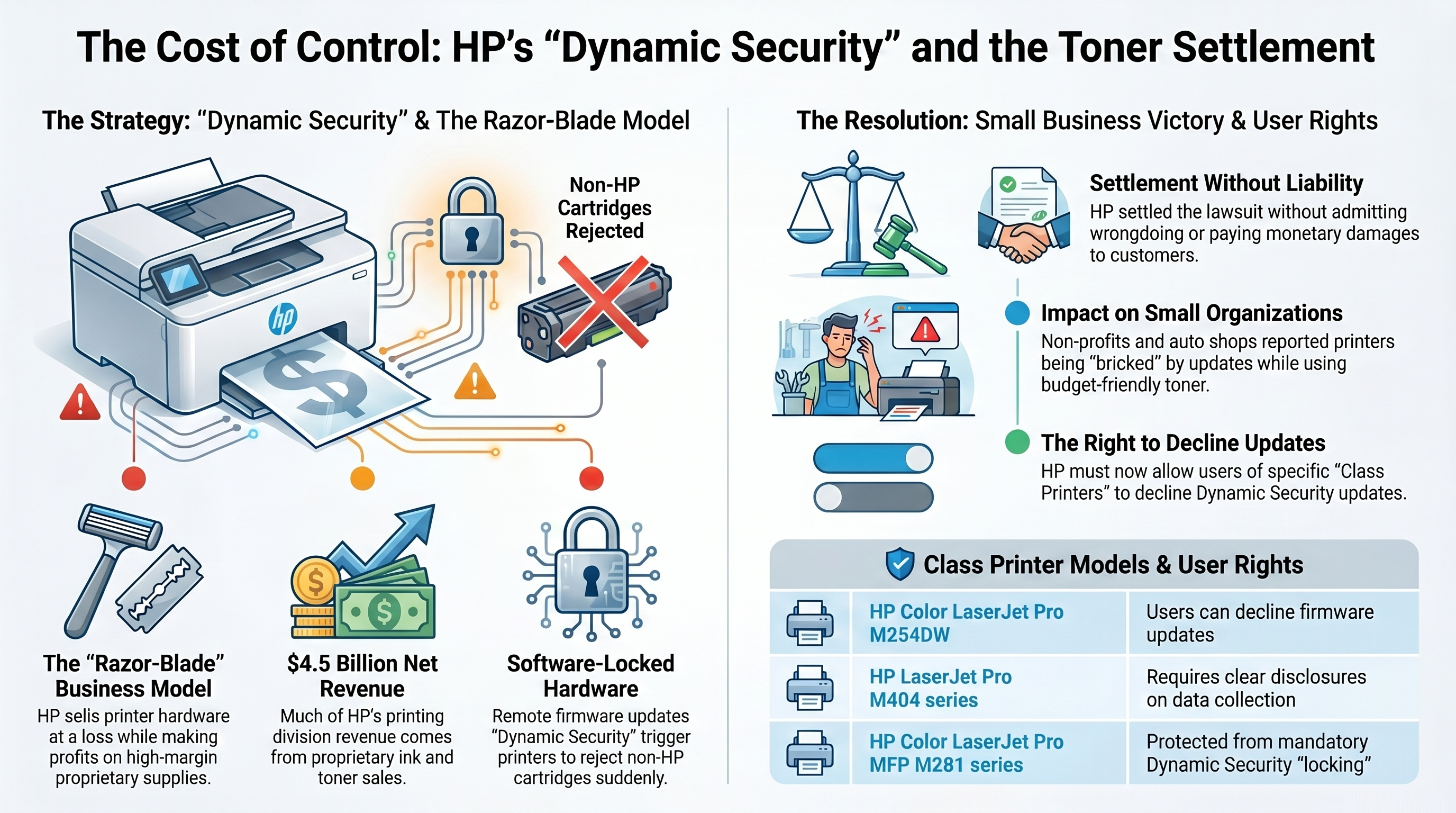
For small organisations like Mobile Emergency Housing Corp, a remote firmware update suddenly rendered their affordable toner useless.
Performance Automotive reported a similar experience where their printers stopped functioning and halted their entire workflow. These businesses suffered, through operational downtime and unexpected cost inflation because of a remote update they never authorised.
HP defends this practice as a way to protect users from hypothetical security threats.
However, the true driver is the Razor-Blade business model. The company often sells hardware at a loss and relies on the profits from proprietary ink. This strategy forces customers into a closed ecosystem where the manufacturer can unilaterally alter the product.
The settlement now requires HP to allow some users to decline these updates.
Firmware updates act as a tool for remote hardware restriction and control.
Closed ecosystems prioritize recurring sales over the freedom of the consumer.
Remote updates can cause sudden operational downtime for small businesses.
Manufacturers use hypothetical security risks to justify anti-competitive behavior.
Reclaiming Ownership and Trust
The move from physical ownership to digital rent-seeking has fundamentally changed our relationship with technology.
We are now encouraged to accept that our devices are never truly ours. To navigate this landscape, readers should develop a sense of algorithmic skepticism. You should look past the marketing labels and the inflated benchmark scores.

Transparency is the only way for the tech industry to repair its relationship with the public.
Manufacturers must be honest about when AI is generating synthetic detail and when hardware is being gated for profit. Reclaiming our rights as owners requires us to demand products that are reliable and static.

True innovation should be found in the quality of the hardware rather than the cleverness of the deception. Reclaiming trust will require a return to the delivery of tangible goods and honest engineering.