Tech
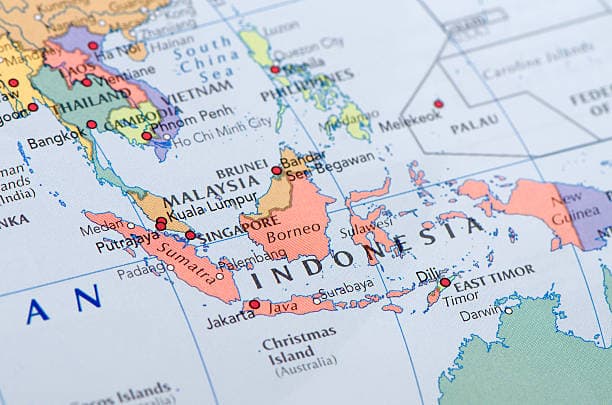
Is Southeast Asia The Next Big AI Market?

TL;DR
Southeast Asia's AI boom is coming. Given how the global AI race has begun, we are starting to see more countries passively adopting AI while others aggressively pushing out their best models to consolidate their power.
I've been watching the headlines about Southeast Asia's AI boom for a while now. Every few weeks there's another announcement, like a huge corporation committing billions of dollars, a government unveiling a national AI strategy or a startup raising a round with "AI-powered" somewhere in the pitch deck. And each time, the same question comes up: Is this real, or is it the region chasing a trend it can't quite catch up to?
The honest answer is both. Here's what the data actually reveals to us:
The money is very real
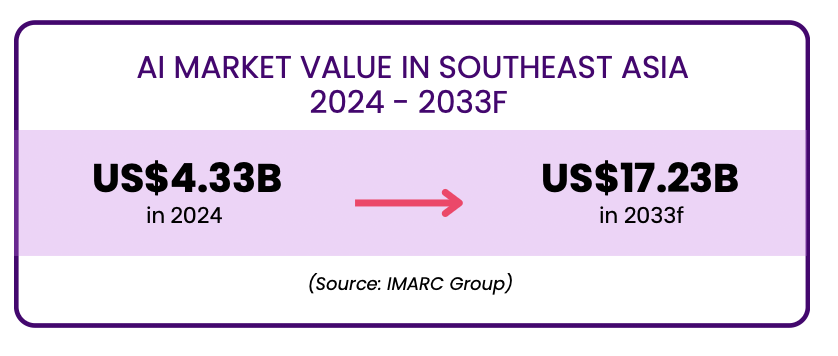
Southeast Asia's AI sector was valued at $4.32 billion in 2024. By 2033, projections put it at $17.22 billion. That's a 16.59% compound annual growth rate.
The physical infrastructure is even harder to argue with. By late 2025, the region had pulled in over $55 billion in AI infrastructure commitments. Microsoft put $2.2 billion into Malaysia. Google and Oracle together committed over $10 billion to Vietnam. Singapore already runs 1.4 GW of data center capacity with a vacancy rate sitting at just 1.4%.
But the VC picture is more complicated
Here's where it gets less clean. In 2024, U.S. private AI investment hit $109.1 billion. China came in at $9.3 billion. Southeast Asia doesn't even register on the same chart. In Q3 2025, the Americas pulled $85.1 billion in venture capital. All of Asia combined got $16.8 billion.
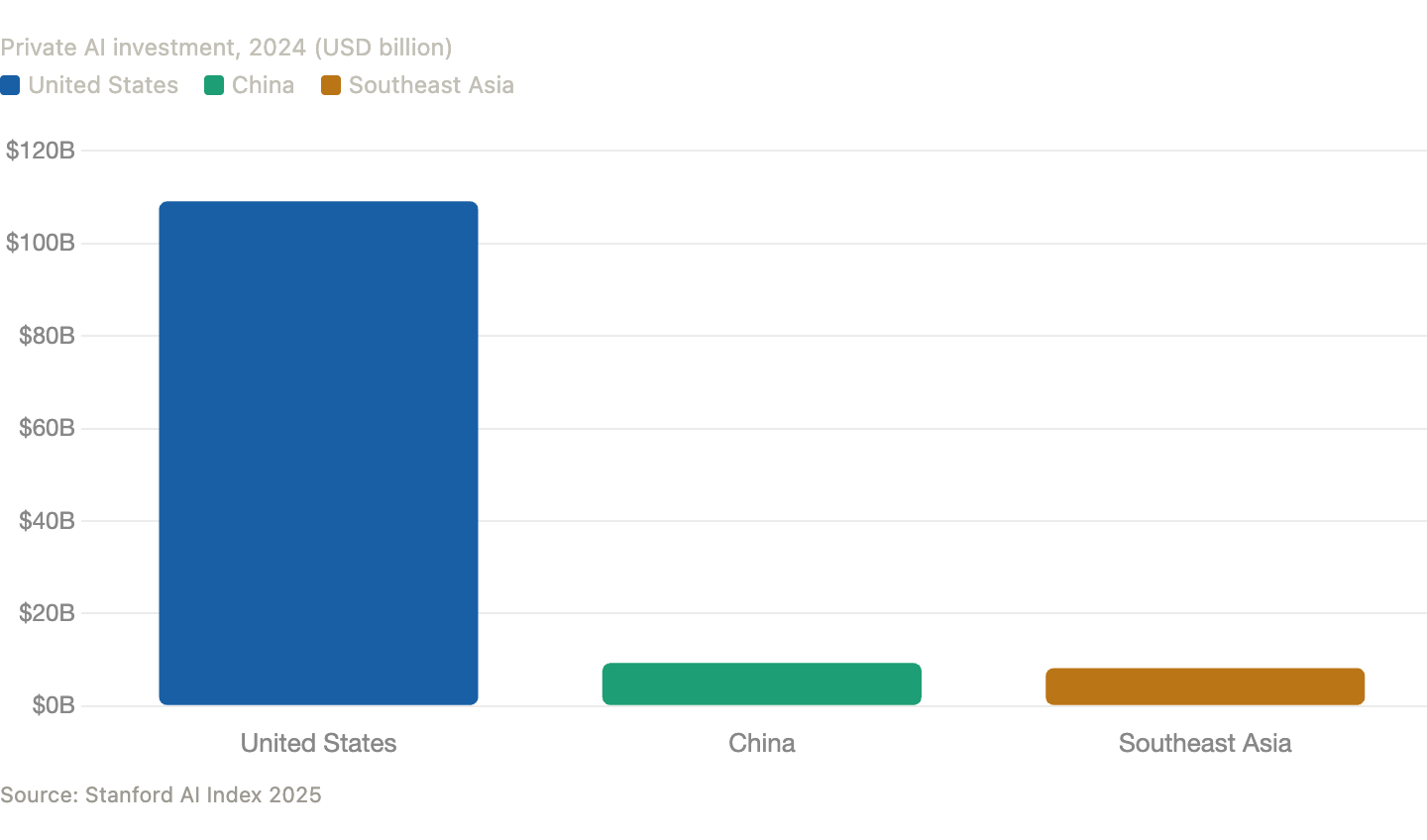
Singapore leads the region with around 20 unicorns, depending on which list you use; Hurun’s 2025 Global Unicorn Index counts 18 Singapore-based unicorns, out of 37 in Southeast Asia. However, these numbers are minute compared to the USA and China.
The gap reflects where foundational AI work is actually happening. Southeast Asian startups are mostly building at the application layer on top of models built elsewhere.
Investors in the region have also shifted focus. The era of throwing money at growth-stage consumer apps is over. What's getting funded now is AI infrastructure provisioning and B2B enterprise tools. In other words, hardware sells while the software market is over-saturated.
The language problem nobody talks about enough
This one actually matters more than most people realise. GPT-5, Claude Sonnet 4.6, Gemini 3.1 are all predominantly trained on English and Chinese data. Drop them into Southeast Asia and they start making strange mistakes.
Examples include:
Recommending pork to Muslim users.
Misreading formal Bahasa Indonesia dialects.
Getting Vietnamese idioms completely wrong.
AI Singapore has been quietly building a fix for this. SEA-LION is a $70 million initiative that takes open-source base models like Meta's Llama, Google's Gemma and continues pre-training them on 200 billion tokens of Southeast Asian language data. The current version supports 13 languages including Indonesian, Vietnamese, Malay, Thai, Burmese, Lao, Tamil, Javanese, Sundanese, and Khmer.
GoTo, the Indonesian tech conglomerate behind Gojek and Tokopedia, already adopted SEA-LION as the base for their internal model called Sahabat-AI. Their reported accuracy in Bahasa Indonesia and Javanese beats comparable global models.
Malaysia is going further. YTL Corporation and Universiti Malaya are building ILMU from scratch at the foundational level. It's expensive and slow, but if it works, Malaysia owns the entire stack.
The part that should concern everyone
Here's the number that keeps coming back to me. Surveys suggest that well over 70% of companies in ASEAN have experimented with generative AI in some form, but one regional analysis estimates that around 85% of these initiatives have so far failed to deliver tangible business ROI.
Think about that for a second.
The reasons are predictable in hindsight. Companies deployed AI to seem innovative rather than to solve an actual problem. Legacy data systems couldn't support model training. Employees didn't trust outputs they couldn't explain. The gap between a working demo and a working business process turned out to be enormous.
Singapore is seeing a sharp spike in demand for AI skills, and most companies say talent is now one of their biggest bottlenecks. Surveys of Southeast Asian firms find that a majority of organisations investing in AI struggle to find employees with the right mix of technical and domain skills, and many workers say they feel unprepared for the shift. The companies that are making AI work (e-commerce, healthcare, manufacturing) are the ones that found ways to hire or train people who understand both the model and the business problem.
Where it's actually working
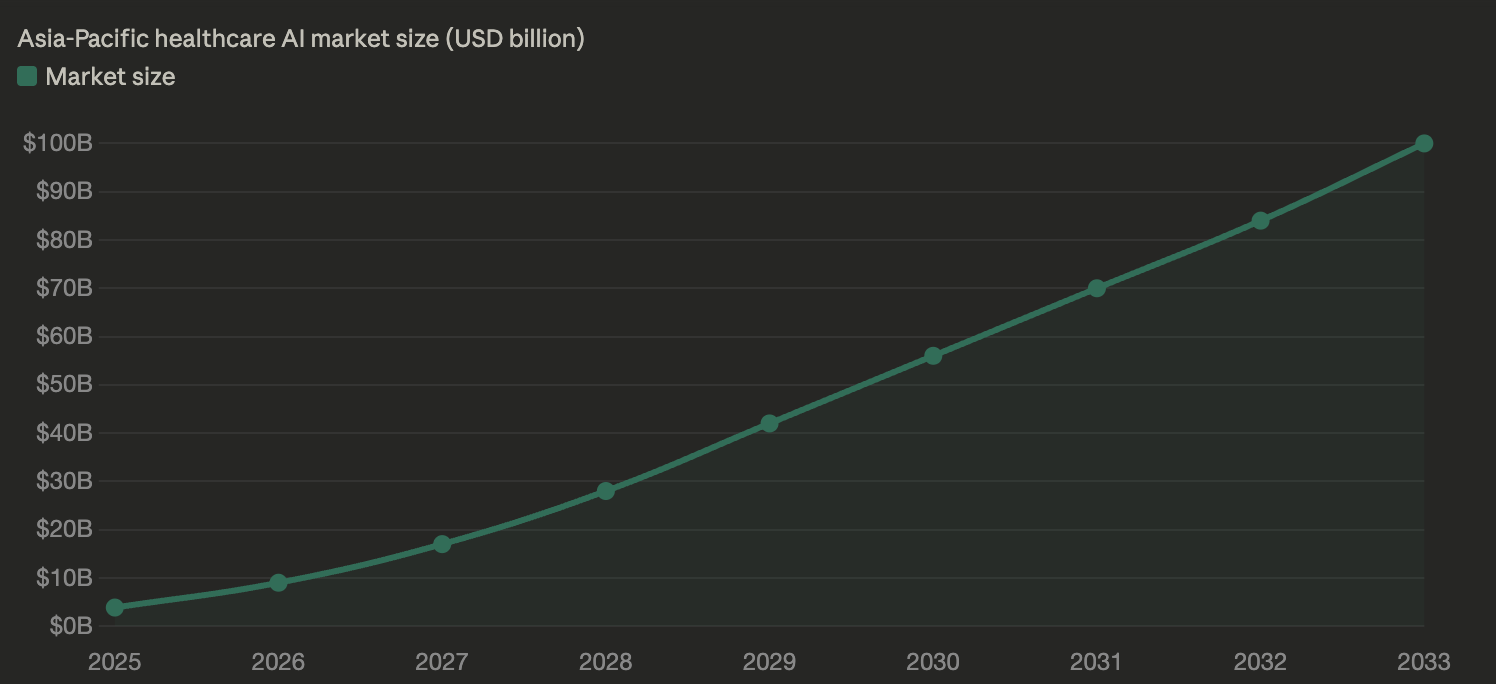
Healthcare is the clearest win so far. Across Asia-Pacific, digital health and AI‑enabled care are forecast to reach well into the tens of billions of dollars by the early 2030s, with strong growth in telemedicine, diagnostics and conversational health tools. The reason it's working isn't some breakthrough in medical AI. Instead of building dedicated patient portals nobody uses, providers plugged AI triage and diagnostics directly into WhatsApp, LINE, and Zalo for more outreach. Rural populations that never had access to a specialist now get AI-assisted triage in their own language through an app they use to chat with family.
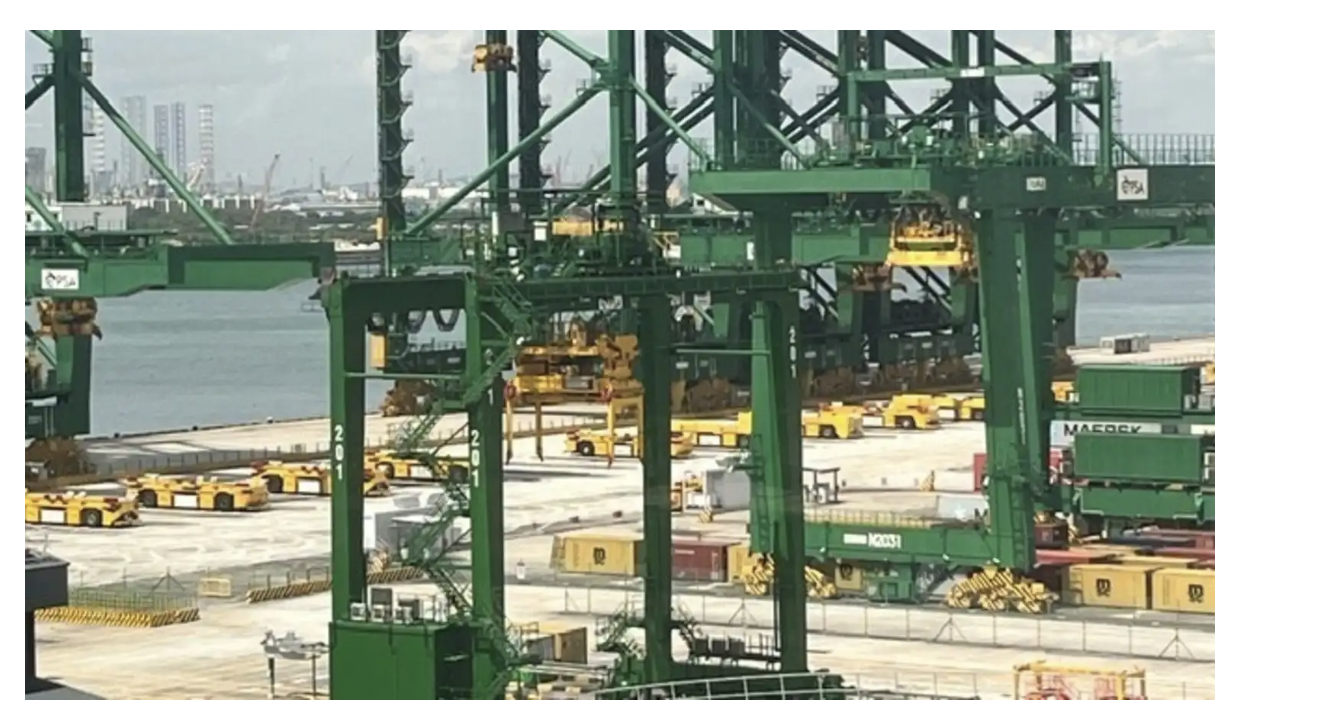
On a side note, Singapore's Tuas Port is another one worth watching. It has a highly automated, AI‑driven port running on next‑generation 5G connectivity, handling millions of container units with minimal on‑site operators.
Manufacturing is also catching up. Manufacturing accounts for around one‑fifth of ASEAN’s GDP, with countries like Thailand, Vietnam and Malaysia even more manufacturing‑heavy than the regional average. Factories are deploying digital twins to predict maintenance failures before they happen. The ROI here is measurable and immediate, which is probably why adoption has been faster than in sectors where the value is harder to quantify.
The regulatory mess nobody wants to fix
Southeast Asia has no equivalent of the EU AI Act. ASEAN published an AI Governance and Ethics guide in 2024, expanded it in 2025 to cover generative AI, and then... made it completely non-binding.
The result is a mess.
Singapore runs a pro-business regulatory sandbox where you can experiment with AI and the rules are clear. Vietnam passed sweeping data protection laws in 2025 that require rigorous impact assessments before any data crosses borders, effective 2026. Malaysia is somewhere in between, updating its data protection act with fines up to MYR 1,000,000 while simultaneously trying to attract AI investment.
AI needs A LOT of data to work. Over 75% of regional business leaders say harmonised data flow agreements are essential to scaling AI investment.
So, hype or not?
The infrastructure build and numbers don't lie. The sovereign model work is serious and filling a genuine gap. The commercial adoption numbers are rough but the sectors that figured it out are generating real returns.
What Southeast Asia isn't, and probably won't be in the next five years, is a place that challenges OpenAI or builds the next foundational model that changes how the world works. The capital gap is too large, the talent pool too small, and the regulatory environment too fragmented for that.
What it can be is the place where AI gets deployed at scale in ways that actually make sense for 400 million people who don't speak English as a first language, who use WhatsApp as their primary interface or whose industries were underserved by the first wave of Western tech.
Whether the region capitalises on it depends on three things:
Upskilling workers fast enough
Sorting out cross-border data agreements
Companies figuring out that deploying AI to solve a real problem is completely different from deploying it to look like they're doing something.